
In Singapore, the death penalty is normalised within a segment of society where state-sanctioned killings are rationalised while showing little empathy for those condemned. How big and constant a “segment” still remains to be determined.
In the meantime, the pro-death penalty discourse in Singapore reveals a disturbing trend, where people rationalise executions through intellectual arguments about deterrence, moral responsibility, and societal protection, presenting these killings as both necessary and justified. Emotional, ironic, and hyperbolic narratives further reinforce this punitive logic, sidelining human rights and the dignity of offenders.
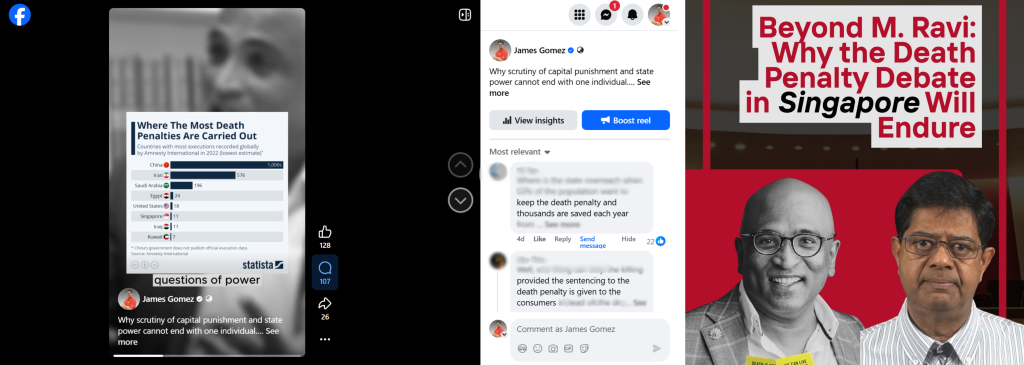
These observations were recently discerned from online comments to a video I posted on 2 January 2026, on my social media handles: “Why scrutiny of capital punishment and state power cannot end with one individual”. In the video I argued that the movement against the death penalty in Singapore will endure and continue to challenge state overreach in spite of the complicated circumstances surrounding the death of its key icon M Ravi.
In four days, around 120 comments were made on my Tiktok and Facebook handles, which promote the dominant Singapore law-and-order narratives. The posts, rather than engaging with questions of accountability or proportionality, were aimed at normalising state power over life and death, revealing how online comments supposedly represent “netizens” support for the government’s executions in Singapore.
i. “ A life for a life. Keep it. It defer to others to commit serious crimes like killing and drug trafficking”
ii. “Even with the death penalty there are people still challenging it. To keep Singapore safe keep the death penalty for good”
Many of the posts are overtly dehumanizing, reducing people on death row to abstract threats rather than human beings, while others adopt a cold, intellectual tone that treats execution as a logical solution rather than an irreversible act of violence.
Phrases invoking deterrence, responsibility, and social order dominate, often expressed through hypothetical scenarios that justify killing one person to “save” many others.
i. “he is absolutely right but drugs should be hanging because we are small country and l believe the government is right for giving death sentence”
What is more troubling is that this worldview is not marginal, but actively reinforced by the state. By framing the death penalty as essential for deterrence, public safety, and moral order, the state aids in normalising fear-based reasoning and punitive absolutism, leaving little space for empathy, rehabilitation, or dissent.
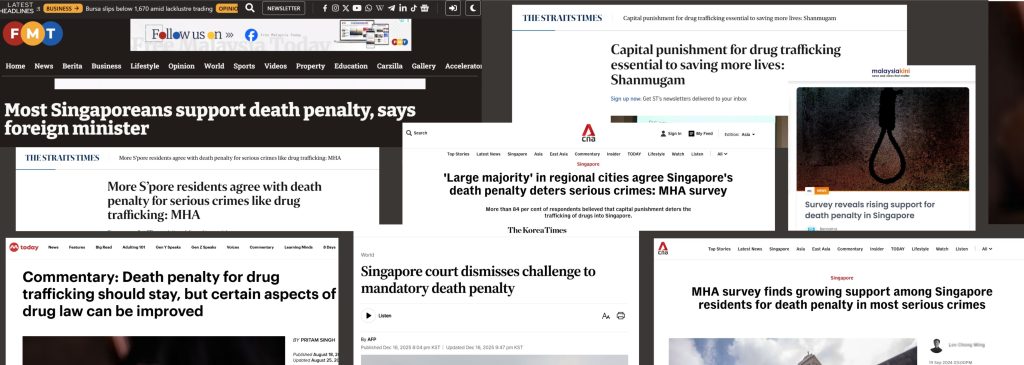
Worse still, many “netizens” unquestioningly support this logic, saying that harsh punishment is both necessary and just. Buying into government authority to administer state-sanctioned killing reinforces the idea that executions are morally and socially legitimate, discouraging critical reflection or opposition.
These narratives are further bolstered by surveys conducted or cited by government-linked services claiming widespread public support for the death penalty. However, other studies such as the survey done by the National University of Singapore, Faculty of Law, “Public Opinion On The Death Penalty In Singapore: Survey Findings”, challenge these findings, saying that while high abstract support is often reported, actual support for the mandatory death penalty drops substantially when respondents are presented with specific case scenarios.
What is strikingly obvious is the authenticity of the commentators: the use of fake profiles is high. Many of the social media accounts have extremely low follower or friend counts, locked profiles, minimal posting histories and post histories that attack non-government views.
In Singapore, it has been widely recognised that so-called “Internet Brigades” employ astroturfing tactics to manufacture the illusion of widespread public support. These interventions do not engage substantively with the arguments at hand; instead, they deliberately divert attention by appealing to emotion, moralising dissent, or resorting to ad hominem attacks.
In Singapore, when killing is defended as logic, empathy becomes expendable. What these comments reveal is not merely support for the death penalty, but a deeper moral erosion in which state-sanctioned killing is celebrated, dissent is mocked, and human life is reduced to a policy tool.
As for the “commenters”, their trolling, insults, and fake outrage should mean nothing to anyone with conviction or the movement itself. Such “comments” should be treated as merely manufactured content designed to manipulate and shift the narrative against the anti-death penalty movement.