
Civil society remains a central pillar in sustaining democratic systems, and its impact is strongest when it works in partnership with democracy-supporting political parties. Across Asia, as well as in Singapore however, these two actors often operate in parallel rather than in coordination.
Efforts to bring civil society organisations and political parties together are frequently met with hesitation and discomfort from both sides. These internal reservations are often compounded by external pressures from actors who have little interest in seeing such alliances emerge. Recognising and overcoming these barriers is essential to normalising collaboration between the two sectors.
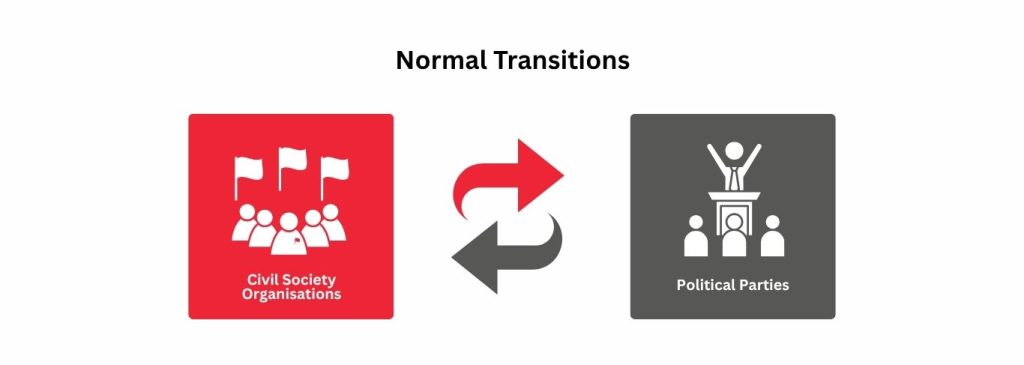
Interaction between civil society and political parties already occurs in practice. Civil society actors often enter party politics during periods of political change, such as elections, while politicians frequently transition into civil society roles after leaving public office.
These patterns of movement demonstrate that the boundary between the two spheres is more fluid than is often acknowledged. Strengthening and legitimising these “transitions” can help establish collaboration as a routine and accepted feature of democratic life in Asia.
In Singapore, the dynamics of civil society–political party engagement are shaped by a strictly regulated political context in which electoral politics is highly institutionalised and the space for formal coalitions between societal actors and parties are ideologically discouraged.
Civil society organisations (CSOs) play an active role in advocacy, policy feedback, and issue awareness, particularly around social policy, rights-based concerns, and governance reform. However, they often operate in parallel to political parties rather than in structured partnership with them. While there are instances of informal interaction—such as issue-based consultations, public forums, or individuals moving between civil society and party politics—these relationships are generally cautious and episodic rather than institutionalised.
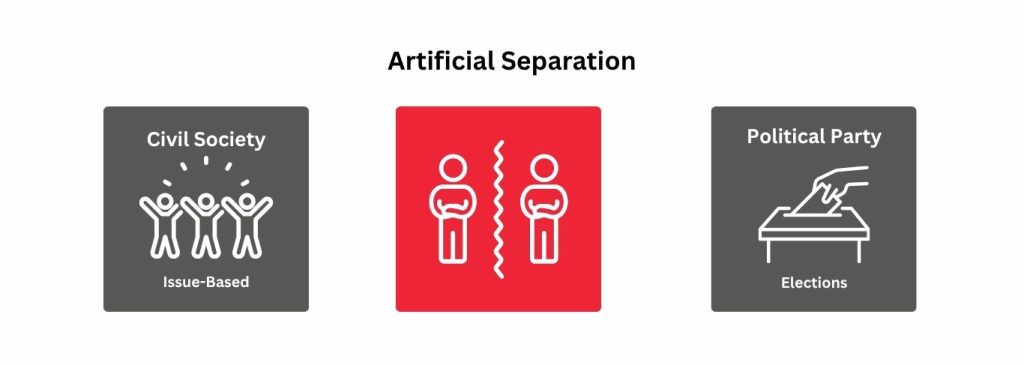
A key constraint is the prevailing norm that political activity is primarily the domain of political parties, while civil society is expected to remain non-partisan and issue-focused. This has contributed to a cautious approach on both sides: civil society actors often avoid formal alignment with parties to preserve performative neutrality and operational space, while political parties may be wary of appearing overly aligned with advocacy groups, and in doing so, unwittingly maintain the artificial separation between the two. As a result, collaboration tends to be discreet, indirect, issue-specific, and carefully managed rather than strategic or structural.
Meanwhile, Singapore’s evolving democratic landscape shows signs of gradual interaction. Civil society groups increasingly engage with political parties through manifesto and policy position queries, while political parties—especially opposition parties—draw on civil society expertise in areas such as social policy, inequality, and governance reform. These interactions suggest an emerging but still a nascent engagement.
In the region, there are cases of more structured civil society–political party collaboration – often occurring at the cusp of regime change. However, in Singapore’s setting, such collaboration is likely to remain stagnant, unless active steps are taken to build trust, spur informal cooperation, and foster issue-based alignment, and counter ideological rhetoric that seeks to keep these two entities apart. Only then can any deeper institutional partnerships emerge.
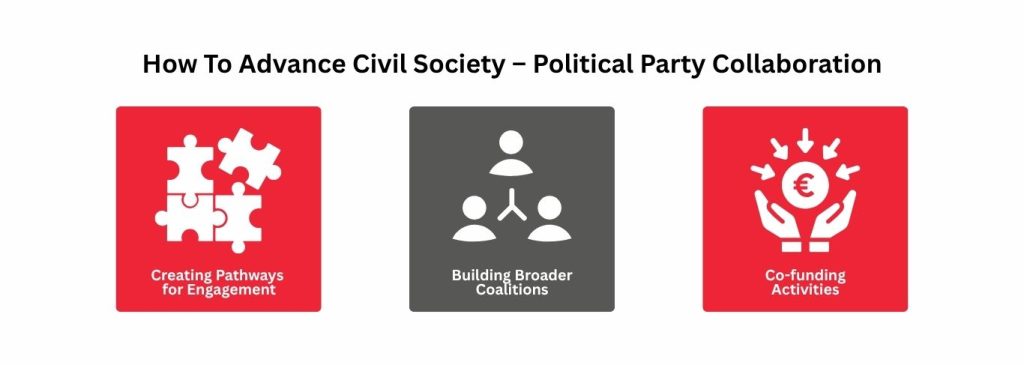
To advance this agenda in Singapore, several practical steps can be taken.
- Political parties can open up their structures to civil society by creating pathways for engagement, including individual associate memberships, organisational affiliations or project-based partnership arrangements.
- Expanding outreach beyond traditional geographic or political bases can also help build broader coalitions committed to democratic governance.
- In addition, co-funding activities can strengthen institutional cooperation and long-term sustainability, enabling more consistent collaboration across sectors.
If formal partnerships are deemed not yet feasible in Singapore, incremental approaches can play an important role. Structured dialogues, joint workshops, and collaborative platforms can bring together representatives from both sectors to exchange perspectives, build mutual understanding, and reduce mistrust. These initial engagements can serve as entry points for deeper cooperation over time in the city-state.
Ultimately, the case for civil society–political party partnerships rests on the need to widen democratic participation and resilience. By working together, these actors can expand their networks, bridge societal and institutional divides, and contribute to building a more broad-based and adaptive democratic movement in Asia.